
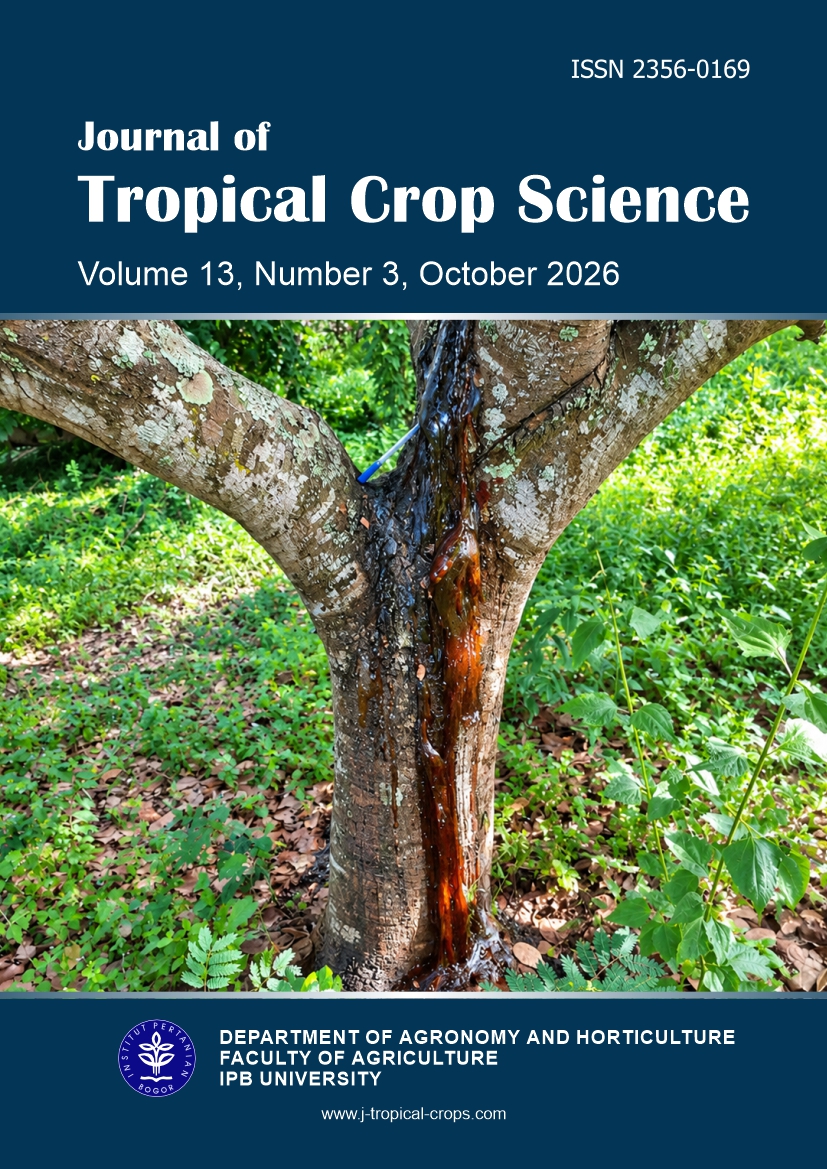
Pathogenicity Evaluation of Lasiodiplodia spp. as the Causal Agent of Cashew Gummosis (Anacardium occidentale L.) in Côte d’Ivoire
DOI:
https://doi.org/10.29244/jtcs.13.03.681-689Keywords:
agroecological zones, cashew, pathogenicity, virulenceAbstract
Cashew gummosis is an emerging phytopathological threat showing an expanding distribution across Côte dʹIvoire. Elucidating the primary etiological agent is a critical prerequisite for developing targeted disease management strategies. To this end, a total of 105 fungal isolates comprising the genera Lasiodiplodia, Pestalotia, and Ceratocystis, which were recovered from symptomatic gummosis lesions were evaluated.Two distinct inoculation protocols were used: mechanically wounded and non-wounded cortical tissue applications. The bioassays showed that macroscopic symptoms developed exclusively following the wounded inoculation protocol, confirming that structural tissue compromise was necessary for fungal entry. Furthermore, symptoms typical of gummosis were confined to seedlings inoculated with Lasiodiplodia isolates. Successful re-isolation of the fungus from newly induced lesions satisfied Koch’s postulates, confirming that this genus is the causative agent of cashew gummosis in Côte dʹIvoire. Agglomerative hierarchical cluster analysis based on virulence parameters categorized the pathogenic Lasiodiplodia population into three distinct phenotypic clusters. Consequently, this study establishes Lasiodiplodia spp. as the principal pathotype driving cashew gummosis in Côte dʹIvoire and highlights intrageneric pathogenic diversity within the genus.
References
Abbas, A. (2018). First report of gummosis disease of major fruits in Gilgit-Baltistan (GB), Pakistan. International Journal of Life Sciences Scientific Research, 4(3), 1805–1809. https://doi.org/10.21276/ijlssr.2018.4.3.11
Babatunde, O. P., Adeigbe, O. O., Sobowale, O. I., Muyiwa, A. A., & Balogun, S. T. (2023). Cashew production and breeding in 5 West African countries. Journal of Scientific Research and Reports, 29(5), 28–39. https://doi.org/10.9734/jsrr/2023/v29i51745
Barnett, H. L., & Hunter, B. B. (1972). Illustrated genera of imperfect fungi. Burgess Publishing.
Cardoso, J. E., Bezerra, M. A., Viana, F. M. P., Sousa, T. R. M., Cysne, A. Q., & Farias, F. C. (2009). Ocorrência endofítica de Lasiodiplodia theobromae em tecidos de cajueiro e sua transmissão por propágulos. Summa Phytopathologica, 35(4), 262–266. https://doi.org/10.1590/S0100-54052009000400002
Cissé, I., Soro, S., Traoré, A., Abo, K., Silué, S., & Koné, D. (2024). Level of distribution of cashew gummosis (Anacardium occidentale L.) in Côte d’Ivoire. International Journal of Agriculture and Biological Sciences, 35–43. https://doi.org/10.5281/zenodo.14795061
Coutinho, I. B. L., Freire, F. C. O., Lima, C. S., Lima, J. S., Gonçalves, F. J. T., Machado, A. R., Silva, A. M. S., & Cardoso, J. E. (2017). Diversity of genus Lasiodiplodia associated with perennial tropical fruit plants in northeastern Brazil. Plant Pathology, 66(1), 90–104. https://doi.org/10.1111/ppa.12565
Dembélé, D. D., Kamara, A., Grechi, I., Silué, N., N’goran, N. S., Yéo, Y. S., Rey, J. Y., & Koné, D. (2020). Morphological characteristics and distribution of Colletotrichum isolates morphotypes infecting mango (Mangifera indica L.) in the north of Côte d’Ivoire. African Journal of Food, Agriculture, Nutrition and Development, 20(3), 15837–15856. https://doi.org/10.18697/ajfand.91.18840
Dendena, B., & Corsi, S. (2014). Cashew, from seed to market: A review. Agronomy for Sustainable Development, 34(4), 753 772. https://doi.org/10.1007/s13593-014 0240-7
Dianda, O. Z., Kansie, Y., Wonni, I., & Dianâ, F. (2025). Phylogeny and pathogenicity of Lasiodiplodia species associated with gummosis and dieback of cashew (Anacardium occidentale L.) in Burkina Faso. Physiological and Molecular Plant Pathology, 138, Article 102698. https://doi.org/10.1016/j.pmpp.2025.102698
Endes, A., & Kayim, M. (2022). Morphological and molecular characterization of Botryosphaeriaceae species associated with dieback and gummosis on plum trees in Turkey. Comptes Rendus de l’Académie Bulgare des Sciences, 75(2), 295–302. https://doi.org/10.7546/CRABS.2022.02.16
Food and Agriculture Organization of the United Nations. (2023). FAOSTAT statistical database. https://www.fao.org/faostat/fr/#data/QCL
Fontaine, F., Pinto, C., Vallet, J., Clément, C., Gomes, A. C., & Spagnolo, A. (2015). The effects of grapevine trunk diseases (GTDs) on vine physiology. European Journal of Plant Pathology, 144(4), 707–721. https://doi.org/10.1007/s10658-015-0770-0
Gariba, A. A., Amoah, R. S., Honger, J. O., & Deha, C. I. (2025). A comprehensive review of post-harvest stem end rot of mango caused by Lasiodiplodia theobromae [Preprint]. Preprints. https://doi.org/10.20944/preprints202511.1970. v1
Gomdola, D., Jeewon, R., Jayawardena, R. S., Pem, D., & Harishchandra, D. L. (2020). A new record of Lasiodiplodia pseudotheobromae causing leaf spot of Cynometra malaccensis in Thailand. Plant Pathology & Quarantine, 10(1), 223–237. https://doi.org/10.5943/PPQ/10/1/21
Ismail, A. M., Cirvilleri, G., Polizzi, G., Crous, P. W., Groenewald, J. Z., & Lombard, L. (2012). Lasiodiplodia species associated with dieback disease of mango (Mangifera indica) in Egypt. Australasian Plant Pathology, 41(6), 649–660. https://doi.org/10.1007/s13313-012-0163-1
Lebailly, P., Lynn, S., & Seri, H. (2012). Étude pour la préparation d’une stratégie pour le développement de la filière anacarde en Côte d’Ivoire [Diagnostic Report]. University of Liège.
Li, Z., Wang, Y. T., Gao, L., Wang, F., Ye, J. L., & Li, G. H. (2014). Biochemical changes and defense responses during the development of peach gummosis caused by Lasiodiplodia theobromae. European Journal of Plant Pathology, 138(1), 195 205. https://doi.org/10.1007/s10658-013 0322-4
Munirah, M. S., Azmi, A. R., Yong, S. Y. C., & Izzati, N. A. M. Z. (2017). Characterization of Lasiodiplodia theobromae and L. pseudotheobromae causing fruit rot on pre-harvest mango in Malaysia. Plant Pathology & Quarantine, 7(2), 202–213. https://doi.org/10.5943/ppq/7/2/14
Muntala, A., Norshie, P. M., Santos, K. G., & Saba, C. K. S. (2020). Colletotrichum gloeosporioides species complex: Pathogen causing anthracnose, gummosis and dieback disease of cashew (Anacardium occidentale L.) in Ghana. European Journal of Agriculture and Food Sciences, 2(6), Article 146. https://doi.org/10.24018/ejfood.2020.2.6.146
Netto, M. S. B., Assunção, I. P., Lima, G. S. A., Marques, M. W., Lima, W. C., Monteiro, J. H. A., Balbino, V. Q., Michereff, S. J., Phillips, A. J. L., & Câmara, M. P. S. (2014). Species of Lasiodiplodia associated with papaya stem-end rot in Brazil. Fungal Diversity, 67(1), 127–141. https://doi.org/10.1007/s13225-014-0279-4
Obrador-Sánchez, J. A., & Hernandez-Martínez, R. (2020). Microscope observation of Botryosphaeriaceae spp. in the presence of grapevine wood. Phytopathologia Mediterranea, 59(1), 119–129.
Phillips, A. J. L., Alves, A., Abdollahzadeh, J., Z., Slippers, B., Wingfield, M. J., Groenewald, J. & Crous, P. W. (2013). The Botryosphaeriaceae: Genera and species known from culture. Studies in Mycology, 76, 51–167. https://doi.org/10.3114/sim0021
R Core Team. (2023). R: A language and environment for statistical computing. R Foundation for Statistical Computing. https://www.R-project.org/ Rangel-Montoya, E. A., Paolinelli, M., Rolshausen, P. E., Valenzuela-Solano, C., & Hernandez-Martinez, R. (2021). Characterization of Lasiodiplodia species associated with grapevines in Mexico. Phytopathologia Mediterranea, 60(2), 237 251. https://doi.org/10.36253/phyto-12576
Rangel-Montoya, E. A., Rolshausen, P. E., & Hernandez-Martinez, R. (2023). Unravelling the colonization mechanism of Lasiodiplodia brasiliensis in grapevine plants. Phytopathologia Mediterranea, 62(2), 135–149. https://doi.org/10.36253/phyto-14198
Sha, S., Wang, Z., Hao, H., Wang, L., & Feng, H. (2021). First report of canker disease in apple caused by Lasiodiplodia theobromae in China. Acta Medica Mediterranea, 37(6), 3525–3528.
Silué, N., Soro, S., Koné, T., Abo, K., Koné, M., & Koné, D. (2017). Parasitical fungi in cashew (Anacardium occidentale L.) orchard of Cote d`Ivoire. Plant Pathology Journal, 16(2), 82–88. https://doi.org/10.3923/ppj.2017.82.88
Verma, S., Thakur, A., & Gautam, H. R. (2021). Evaluation of fungicides against Botryodiplodia theobromae; the incitant of mango dieback and gummosis. Plant Disease Research, 36(2), 129–135. https://doi.org/10.5958/2249-8788.2021.00021.4
Wonni, I., Sereme, D., Ouedraogo, I., Kassankagno, I. A., Dao, I., Ouedraogo, L., & Nacro, S. (2017). Diseases of cashew nut plants (Anacardium occidentale L.) in Burkina Faso. Advances in Plants & Agriculture Research, 6(3), 78–83. https://doi.org/10.15406/apar.2017.06.00216
Downloads
Published
How to Cite
Issue
Section
License
All publications by Journal of Tropical Crop Science is licensed under a Creative Commons Attribution-ShareAlike 4.0 International License.


