
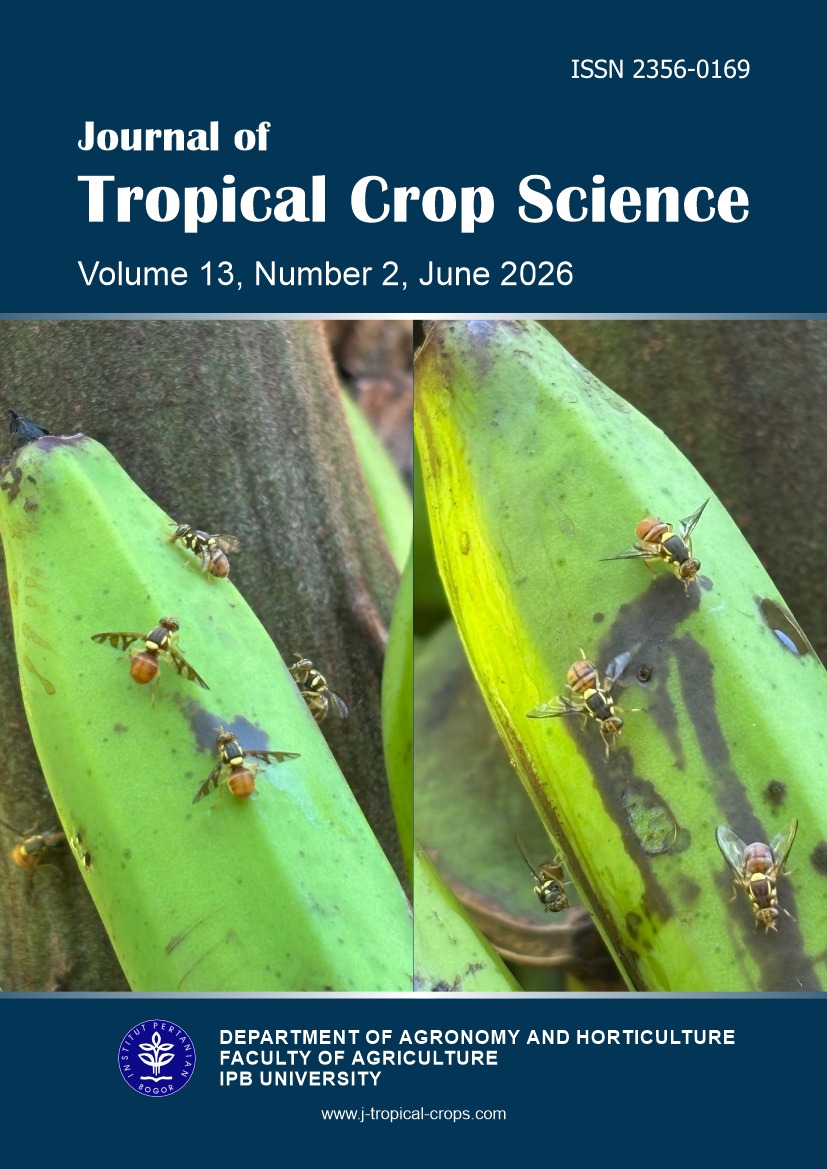
Diversity and Species Composition of Fruit Flies (Diptera: Tephritidae) in Keerom, Papua, Indonesia
DOI:
https://doi.org/10.29244/jtcs.13.02.407-418Keywords:
agroecosystem, Bactrocera, diversity, methyl eugenol, PapuaAbstract
Information on fruit flies is essential for integrated fruit fly control programs, whilst such information remains very limited in Papua. This study aims to determine the species diversity and abundance of fruit flies in agroecosystems (Yuwanain) and secondary forest ecosystems (Ubiyau) in Arso District, Keerom Regency. Sampling locations were determined using purposive sampling. Fruit fly samples were collected using plastic bottle traps baited with methyl eugenol. Observations were conducted during May and June 2025. Four species of fruit flies were found in Arso District: Bactrocera musae, B. umbrosa, B. fulvicauda, and B. dorsalis complex. All four species were found in the agroecosystem area in Yuwanain, whilst in the secondary forest in Ubiyau, only three species were found: B. musae, B. umbrosa, and B. fulvicauda. All species were pests except B. fulvicauda. The Shannon-Wiener species diversity index values for fruit flies in the agroecosystem (H’ = 0.7) and in the secondary forest (H’ = 0.4) were both categorized as low. The Simpson Dominance Index in Yuwanain was classified as moderate (D = 0.636), whilst in Ubiyau it was categorized as high (D = 0.800). In Yuwanain, B. musae was highly dominant (D = 0.617) with a total individual count of 3,080. The dominance of B. musae in Yuwanain was attributed to the abundance of its primary host plant, banana, in the agroecosystem. The evenness index in Yuwanain village was moderate (E = 0.521), whereas in Ubiyau it was low (E = 0.381), indicating that the distribution of individual numbers for each species was uneven in the Secondary Forest. Fruit fly abundance was higher in the agroecosystem of Yuwanain (3,921 individuals) than in the secondary forest of Ubiyau (2,272 individuals). This difference is likely due to the greater diversity of host plants in the Yuwanain agroecosystem, including banana, papaya, jackfruit, citrus, wax apple, breadfruit, and chili. In contrast, the secondary forest of Ubiyau contains fewer naturally occurring host plants, such as the native Papua banana and breadfruit. It can be concluded that the species composition and abundance of fruit flies at certain habitat types were determined by the diversity and abundance of host plants.
References
Doorenweerd, C., Leblanc, L., Norrbom, A. L., San Jose, M., & Rubinoff, D. (2018). A global checklist of the 932 fruit fly species in the tribe Dacini (Diptera, Tephritidae). ZooKeys, 730, 19–56. https://doi.org/10.3897/zookeys.730.21786
Drew, R. A. I., Alulapictus, D., Aquilus, D., Badius, D., Concolor, D., Discors, D., Dissimilis, D., Impar, D., Maprikensis, D., Melanohumeralis, D., Memnonius, D., Nigriculus, D., & Palmerensis, D. (1989). The tropical fruit flies (Diptera: Tephritidae: Dacinae) of the Australasian and Oceanian Regions. Memoirs of the Queensland 26. Museum, Nature, https://doi.org/10.3316/informit.T2025082200005591546575831
Hassani, I. M., Delatte, H., Ravaomanarivo, L. H. R., Nouhou, S., & Duyck, P. (2022). Niche partitioning via host plants and altitude among fruit flies following the invasion of Bactrocera dorsalis. Agricultural and Forest Entomology, 24(4), 575–585. https://doi.org/https://doi.org/10.1111/afe.12522
Herrahmawati, Q., Yulianti, R., & Yasman, Y. (2023). Short Communication: Dacini tribe’s fruit fly species in Depok (Indonesia) with special reference to the abundance of orchard fly, Bactrocera dorsalis, for fruit pest controlling. Biodiversitas Journal of Biological Diversity, 24(4). https://doi.org/10.13057/biodiv/d240460
Holis, A. I., Haryanto, H., & Isnaini, M. (2023). Populasi dan intensitas serangan lalat buah (Bactrocera spp.) pada pertanaman cabai keriting (Capsicum annum L.) di Desa Darmasari Kabupaten Lombok Timur. Jurnal Ilmiah Mahasiswa Agrokomplek, 2(1), 161–170. https://doi.org/10.29303/jima.v2i1.2332
Hooper, G. H. S., & Drew, R. A. I. (1979). Effect of height of trap on capture of tephritid fruit flies with cuelure and methyl eugenol in different environments 12. Environmental Entomology, 8(5), 786–788. https://doi.org/10.1093/ee/8.5.786
Hudiwaku, S., Himawan, T., & Rizali, A. (2022). Keanekaragaman, komposisi spesies, dan kunci identifikasi lalat buah (Diptera: Tephritidae: Dacinae) di Pulau Lombok. Jurnal Entomologi Indonesia, 19(2), 111. https://doi.org/10.5994/jei.19.2.111
Lamba, K., Abraham, L., Kawi, A. P., Guaf, T., Nugi, A., & Tenakanai, D. (2024). Infestation level of banana fruit fly (Bactrocera musae, Tryon) on Kalapua banana (Musa sp.) in Gazelle Peninsula, Papua New Guinea. Journal of Entomological and Acarological Research, 56(1). https://doi.org/https://doi.org/10.4081/jear.2024.12572
Linda, L., Witjaksono, W., & Suputa, S. (2018). Species composition of fruit flies (Diptera: Tephritidae) in Sorong and Raja Ampat, West Papua. Jurnal Perlindungan Tanaman Indonesia, 22(2), 193. https://doi.org/10.22146/jpti.25280
Magurran, A. E. (1988). Ecological diversity and its Measurement. Springer Netherlands. https://doi.org/10.1007/978-94-015-7358-0
Marquina, D., Buczek, M., Ronquist, F., & Łukasik, P. (2021). The effect of ethanol concentration on the morphological and molecular preservation of insects for biodiversity studies. PeerJ, 9, e10799. https://doi.org/10.7717/peerj.10799
Nanga Nanga, S., Hanna, R., Fotso Kuate, A., Fiaboe, K. K. M., Nchoutnji, I., Ndjab, M., Gnanvossou, D., Mohamed, S. A., Ekesi, S., & Djieto-Lordon, C. (2022). Tephritid fruit fly species composition, seasonality, and fruit infestations in two Central African agro-ecological zones. Insects, 13(11), 1045. https://doi.org/10.3390/insects13111045
Odum, E. P. (2017). Fundamentals of ecology (1953). In The future of nature (pp. 233 244). Yale University Press. https://doi.org/10.12987/9780300188479-022
Papadopoulos, N. T., De Meyer, M., Terblanche, J. S., & Kriticos, D. J. (2024). Fruit flies: Challenges and opportunities to stem the tide of global invasions. Annual Review of Entomology, 69(1), 355 373. https://doi.org/10.1146/annurev-ento-022723-103200
Qin, Y., Ullah, F., Fang, Y., Singh, S., Zhao, Z., Zhao, Z., & Li, Z. (2021). Prediction of potential economic impact of Bactrocera zonata (Diptera: Tephritidae) in China: Peaches as the example hosts. Journal of Asia-Pacific 1101–1106. Entomology, 24(4), https://doi.org/https://doi.org/10.1016/j.aspen.2021.10.004
Sahetapy, B., Uluputty, M. R., & Naibu, L. (2019). Identifikasi lalat buah (Bactrocera spp), pada tanaman cabai (Capsicum annum L.) dan belimbing (Averrhoa carambola L.) di Kecamatan Salahutu Kabupaten Maluku Tengah. Agrikultura, 30(2), 63. https://doi.org/10.24198/agrikultura.v30i2.23659
Setiawan, Y., Hauroinsiyah, F., Hamdoen, F. M., Devi, M. P., & Tarno, H. (2024). Diversity of Fruit flies (Diptera: Tephritidae) attracted by methyl eugenol in carambola and papaya orchads in Malang Regency, East Java, Indonesia. PLANTROPICA: Journal of Agricultural Science, 09(1), 55–60. https://doi.org/10.21776/ub.jpt.2024.009.1.6
Supriatna, J. (2018). Biodiversity indexes: value and evaluation purposes. E3S Web of Conferences, 48, 01001. https://doi.org/10.1051/e3sconf/20184801001
Wilhm, J. L., & Dorris, T. C. (1968). Biological parameters for water quality criteria. BioScience, 18(6), 477–481. https://doi.org/10.2307/1294272
Yuliadhi, K. A., Susila, I. W., Supartha, I. W., Sultan, A., Yudha, I. K. W., Utama, I. W. E. K., & Wiradana, P. A. (2022). Interaction of parasitoids associated with fruit flies attacking star fruit (Averrhoa carambolae) in Denpasar City, Bali Province, Indonesia. IOP Conference Series: Earth and Environmental Science, 980(1), 012051. https://doi.org/10.1088/1755-1315/980/1/012051
Zhao, Z., Carey, J. R., & Li, Z. (2024). The global epidemic of Bactrocera Pests: Mixed species invasions and risk assessment. Annual Review of Entomology, 69(1), 219 237. https://doi.org/https://doi.org/10.1146/annurev-ento-012723-102658
Downloads
Published
How to Cite
Issue
Section
License
All publications by Journal of Tropical Crop Science is licensed under a Creative Commons Attribution-ShareAlike 4.0 International License.


